
The Big Picture
The 2026 ASHRAE Winter Conference and AHR Expo in Las Vegas sent a clear message to the HVAC industry: the way we think about buildings must fundamentally change.
At the center of that shift is ASHRAE Society President Bill McQuade, whose 2025–2026 theme — Healthy Buildings: Designing for Life — captures a growing consensus among engineers, facility managers, and public health experts. A building is no longer just a structure that keeps the weather out. It is an environment that should actively protect the people inside it.
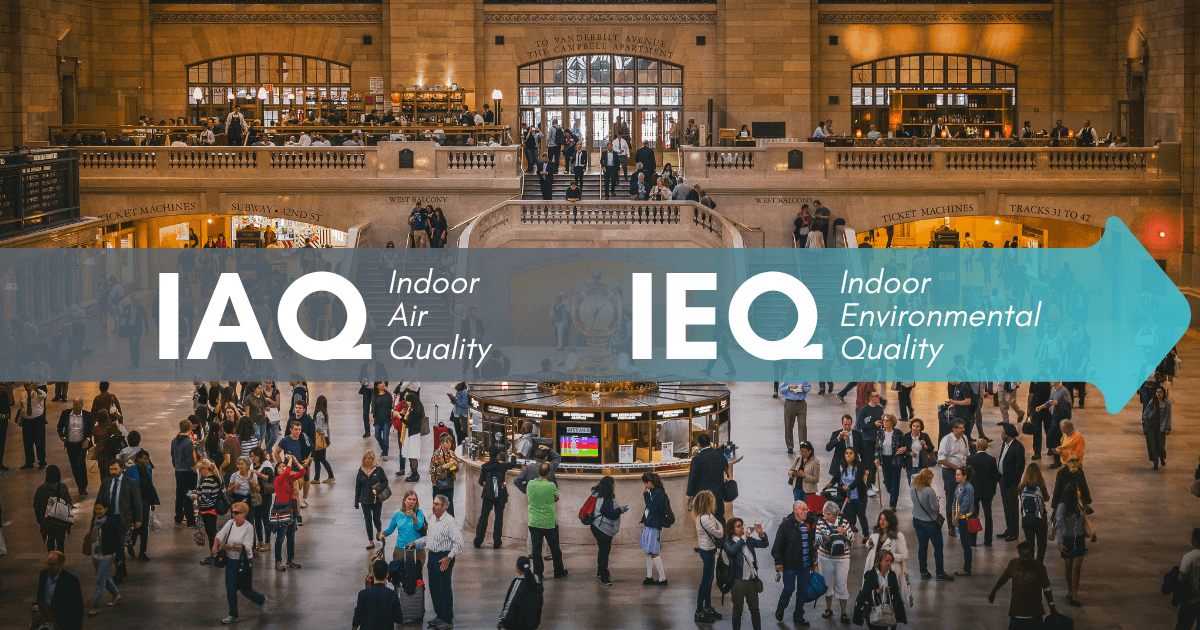
The vehicle for that protection is a concept gaining significant traction: Indoor Environmental Quality, or IEQ.
From Indoor Air Quality to Indoor Environmental Quality: What’s Actually Changing
For decades, the industry’s focus was Indoor Air Quality — IAQ. We measured particulate matter, monitored volatile organic compounds, and optimized ventilation rates. Air was the medium, and cleaning it was the goal.
IEQ builds on that foundation but broadens it considerably. Where IAQ is essentially one dimension of the indoor experience, IEQ is the full picture: every physical and environmental condition inside a building that influences occupant health, comfort, and productivity.
That includes thermal comfort — how occupants perceive temperature, humidity, and airflow — as well as lighting quality, which encompasses both access to natural daylight (critical for healthy circadian rhythms) and customizable task lighting that reduces eye strain. It also includes acoustics: the management of noise levels, sound insulation, and background noise to support concentration and communication.
But perhaps the most consequential expansion is this: IEQ now formally accounts for pathogen transmission, not just chemical contaminants. This was one of the clearest themes to emerge from the conference. ASHRAE’s broader documentation and global research initiatives — including those funded by ARPA-H — explicitly recognize the built environment as a front line of defense against infectious disease.
For those working in active air and surface purification, that recognition is significant.
Air Cleaning Takes Its Place at the Table
For years, the default response to poor indoor air quality was to increase outdoor air intake — open the dampers, dilute the contaminants. That approach is no longer sufficient on its own, and the industry now broadly accepts this.
A clear consensus has emerged: air cleaning devices are a legitimate, necessary component of modern HVAC systems, not an optional upgrade. That consensus has been building since last year’s AHR, and the 2026 conference solidified it. There is also a practical reality behind this shift: in many climates, bringing in more outdoor air creates its own problems. In a city like Atlanta in August, where ozone and particulate levels routinely spike, increasing outdoor air intake can actively degrade IEQ rather than improve it.
Energy efficiency adds another layer of urgency. HVAC systems already account for roughly 40% of a building’s total energy consumption. At a time when the reliability of the energy grid is under increasing strain from extreme weather events, any strategy that improves indoor environmental quality without inflating energy demand is not just desirable — it is essential. Air cleaning devices, properly integrated, contribute to both goals.
The Data Gap: What We Know and What We’re Still Learning
The industry is aligned on the importance of IEQ. It is less aligned — for now — on exactly how much each component contributes.
Ventilation, filtration, and air cleaning each play a role, but their relative contributions under varying real-world conditions are not yet fully understood. The honest answer from researchers and standards bodies alike is that we are still building the evidence base, and that evidence needs to come from real-world settings, not just theoretical models or observational studies.
That work is underway. ARPA-H has funded real-world IEQ research across four specific industries, with schools and healthcare facilities among the first-year focus areas. ASHRAE’s standards — including 62.1 and 170 — are advancing in parallel, gathering the data needed to support updated contaminant limits and control strategies.
Sensor technology is a critical piece of that puzzle, and here the field is still catching up. There is currently no consensus on which sensors or measures should be used to detect pathogens and chemicals in real time. Most existing options are either too large or too costly for widespread deployment across sectors. In the near term, surrogate measures — CO₂ levels and humidity, for instance — are being explored as practical proxies within building energy monitoring systems. Progress is being made in select school districts in Colorado and Nebraska, but practical, scalable sensing remains a work in progress.
What This Means for Existing Buildings
One of the more notable shifts in tone at this year’s conference was an increased focus on existing buildings. Historically, IEQ conversations have centered on new construction, where design flexibility makes it easier to integrate the latest systems and standards.
ASHRAE is now explicitly working to separate guidance for new builds from guidance for retrofits and remodels — an important acknowledgment that the majority of the building stock people occupy today will not be replaced anytime soon. The challenge of improving IEQ in older, less adaptable spaces is real, and the industry is beginning to address it directly.
Also worth noting: ASHRAE is shifting away from proliferating new standards documents and toward frameworks like “Best Practices,” “Case Studies,” and “Centers of Excellence.” This language, common in healthcare and education, prioritizes demonstrated real-world outcomes over prescriptive rules — a meaningful change for practitioners looking to make tangible improvements in the buildings they manage.
The CASPR Perspective
For CASPR Technologies, the direction set at the 2026 ASHRAE conference affirms the case for reactive, continuous air cleaning. Passive filtration captures particles as they pass through a filter; it does nothing for contaminants that never reach that filter. Active purification — delivered continuously out into the occupied space — addresses pathogens and VOCs where people actually are.
As the industry works to close the data gap and standards evolve to reflect real-world complexity, the focus will increasingly fall on technologies that can demonstrate measurable outcomes in the environments where they are deployed. That is the standard CASPR is built to meet.
Looking Ahead to Indoor Environmental Quality
The trajectory is clear. IEQ is not a trend — it is the new baseline for what a well-designed, well-maintained building should deliver. Balancing that standard with energy efficiency goals is the central challenge for facility managers, engineers, and building owners in the years ahead.
The tools to meet that challenge exist. The research to refine and validate them is underway. And the industry, for the first time, is speaking with a unified voice about what healthy buildings actually require.